- The Reason Flour Changes Everything
- What Flour Actually Controls in Your Baking
- Protein Is Only the Beginning
- Flour Strength Explained: W and P/L — The Part Most Bakers Miss
- Flour Strength Cheat Sheet
- How Different Flours Behave: Real Baking Examples
- When You Change Flour, You Change a Living System
- Why Your Recipe Fails When You Swap Flour
- How to Choose the Right Flour
- The Blending Approach — What the Pros Actually Do
- Final Thoughts: Flour Is the System
- Frequently Asked Questions
Same recipe, same method, same hands… and your loaf turned out a disaster! How? If you only changed the flour! If something like this has ever happened to you, this guide is here to fix that. I’m going to walk you through how to choose the best flour for baking better bread, and how to adapt your recipe to the flour you have.
While an ingredient, flour is not just an ingredient; it’s the foundation that controls how your dough behaves from start to finish. Dough or batter, in fact.
In sourdough baking, especially, it can completely change the outcome of a bake, even when everything else stays the same. Because beyond the changes in flour, you are also introducing a change in the dynamic ecosystem of yeast and bacteria of your starter or recipe.
The Reason Flour Changes Everything
Most bakers are familiar with the protein content in flour. Fewer understand the difference between protein content and gluten proteins. And almost nobody realizes that not all gluten behaves the same; that properties like extensibility and tenacity can turn a loaf into either a masterpiece or a complete disaster.
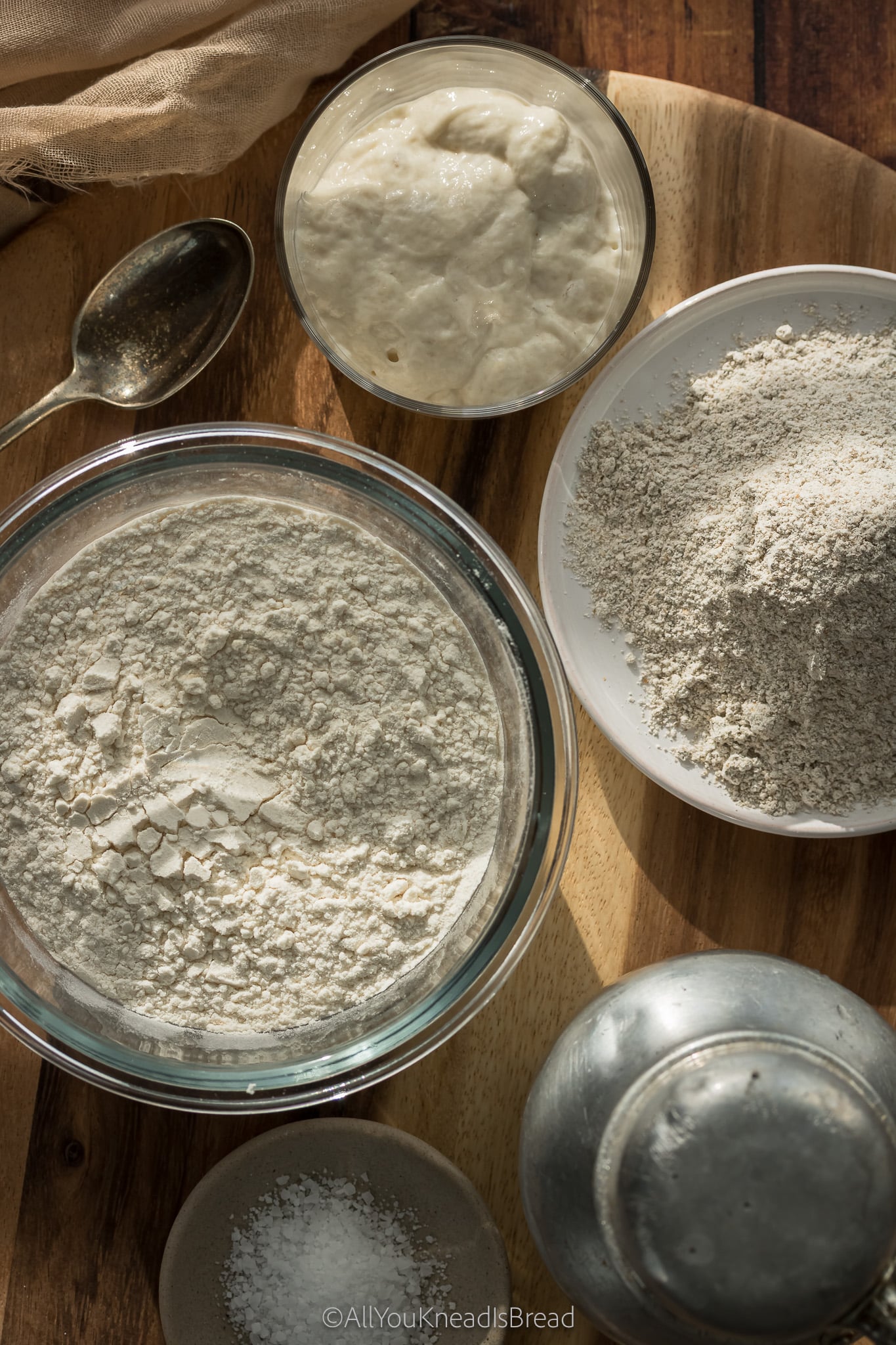
Flour provides structure through gluten-forming proteins that, when mixed with water, develop the famous gluten network. That process is driven by the enzymes, starches, and minerals naturally present in the flour, not just the mechanical part (kneading). Different flours, with different profiles, will have different mechanical needs. You don’t knead all-purpose flour the same as bread flour, right?
But it doesn’t stop there. There is also a biological side to all of this. Fermentation is, after all, the respiration of yeast (and bacteria, too, if you are baking with sourdough). During this process, the polysaccharides are broken into smaller sugar molecules that give the yeasts the necessary energy to produce carbon dioxide and organic acids, which are what make your dough rise and develop its characteristic flavor.
As you can see, flour affects everything! From how much water your dough can absorb, to how fast it ferments, to whether your final bake has a tender crumb or a tight one.
This is true across all of baking:
- Bread: needs gluten strength for structure and crust
- Cakes: need minimal gluten so the crumb stays soft
- Cookies: need controlled spread, gluten can help hold the dough together as the fat melts
- Pastries: need extensibility and delicacy, not toughness
The protein that makes bread chewy is the exact same protein you want to minimize in a cake. Flour itself doesn’t change; what changes is how much of its structure you actually develop, and how you handle it.
What Flour Actually Controls in Your Baking
Let’s break it down into four pillars. Every baking failure or success boils down to at least one of these.
Structure: Gluten and Protein
When flour meets water and mechanical action (mixing, kneading, folding), proteins called glutenin and gliadin hydrate and link together and form what we know as the gluten network. This network gives dough its elasticity and acts like a scaffold, trapping the tiny air bubbles that expand and make bread rise.
Protein content is the most visible indicator of gluten potential. Bread flour typically runs 12–14%, all-purpose flour around 10–12%, and cake flour as low as 7–9%. But protein alone doesn’t tell the whole story. Whole wheat flour can have 14–16% protein, but it still produces a weaker dough than white bread flour due to the bran’s presence.
Hydration: Water Absorption
Different flours absorb water at very different rates, and that’s why two doughs can look completely different even when you follow the same recipe.
- Whole wheat flour absorbs more water than white flour because its bran particles act like tiny sponges. They have lots of molecules that LOVE water, and they absorb it at a much faster pace than gluten can create the network.
- All-purpose flour gives you a moderate, predictable absorption
- Cake and pastry flours absorb less water and produce softer, more slack batters.
You’ve probably even noticed that different brands of the same type of flour absorb water at different rates. That’s because not all wheat varieties have the same properties; some can absorb more water even with the same protein content.
In other words, the same protein content doesn’t mean the same gluten behavior, and it definitely doesn’t mean the same hydration capacity.
This is why a recipe that says ‘70% hydration’ can feel dry with one flour and completely slack with another. Hydration percentages are always relative to the specific flour you’re using.
Fermentation: For Yeast and Sourdough
Flour is not inert in a dough. It contains amylase enzymes that break starch into simple sugars, which yeast and bacteria then consume, and different flours have very different levels of this activity.
- Whole-grain flours are more enzyme-active, which typically speeds up fermentation
- Rye has exceptionally high enzymatic activity; it can make your dough feel slack faster than you’d expect
- White flours are more predictable, but ferment more slowly
Mineral content works the same way. Since most minerals are concentrated in the bran, more minerals mean more bran, and more nutrients for the yeasts and bacteria. Which is why whole-grain flours tend to produce more vigorous starters: there’s simply more to eat.
This is where ash content comes in. In European flour labeling systems, mineral content is expressed as “ash” (not ash present in the flour, but what’s left after the flour is incinerated at high temperature). More ash means more minerals, more bran, more microbial fuel. Higher ash content supports a more active and diverse microbial community, which affects both fermentation speed and flavor development. It’s part of why stone-milled and less refined flours often produce more complex, aromatic bread.
If you’ve baked from European recipes, you’ve probably seen this system already: T45, T55, T65, T80, T110, T150. Those numbers refer to ash content, not protein. A T65 has more minerals than a T55 — meaning more bran, more activity, more flavor potential.
Flour that has been stripped of too many minerals (bran), might have problems during fermentation, especially when using sourdough. The lack of nutrients in the flour means the microorganisms can’t perform at their 100%. If you want to read more about this, you can go to my Troubleshooting my Lievito Madre post, where I had to deal with this very issue!
Flavor and Aroma
Refined white flour has more of a neutral flavor. Whole-grain flours bring overall more complexity: nuttiness, earthiness, and even a slight bitterness from the bran (depending on the grain).
But what are flavor and aroma in bread? In part, they are the result of fermentation: organic acids and volatile compounds (what we know as “aromatics”) that develop as the dough matures. Most of the precursors of these compounds are concentrated in the bran portion of the grain. That’s why whole-grain flours have more potential for flavor and aroma complexity. It’s why a just 10% whole wheat sourdough can taste noticeably richer than one made entirely from white flour.

Protein Is Only the Beginning
If you’ve spent any time in baking communities, you’ve heard protein content is treated like the one number that explains everything. High protein for bread. Low protein for cake. Done.
The problem is that this is incomplete, and it can lead you to make bad substitutions.
Here’s a practical example: two bread flours might both list 13% protein, but perform completely differently in a high-hydration sourdough. One builds a strong, extensible dough that holds its shape through a 16-hour cold retard. The other relaxes too quickly and gives you a flat loaf.
Same protein number. Completely different behavior.
Why? Because protein content measures how much protein is present, not the quality, structure, or balance of those proteins. That’s where the functional measurements come in.
Protein content tells you the potential. W (strength), P (tenacity), and L (extensibility) tell you what the flour actually does with it.
Flour Strength Explained: W and P/L — The Part Most Bakers Miss
Professional bakers and flour millers use a system called the Chopin alveograph to measure two things: how strong flour is, and how that strength is balanced. This gives us three numbers that are, honestly, more useful than protein percentage alone.
The Strength Index: W
W measures the total energy required to inflate and burst a small bubble of dough. Think of it as the flour’s overall horsepower.
- Low W (80–160): weak flour, extensible, struggles to hold structure, good for delicate things or short-process recipes
- Medium W (180–260): versatile, works for most everyday baking
- Strong W (280–350): robust, elastic, handles long fermentation and high hydration well
- Very strong W (350+): professional-grade, designed for panettone, brioche, very long cold fermentations
When you see a flour labeled ‘Manitoba‘ or ‘high-strength,’ that’s typically a W above 320. When you buy supermarket all-purpose, you’re probably working with W 160–220, whether you know it or not.
The Balance Ratio: P/L
P/L measures the balance between two opposing qualities of the dough:
- P (tenacity): measures how strongly the dough resists being stretched. This is elasticity, and the ability of the dough to snap back (if there is no resistance, the dough would behave like a chewing gum).
- L (extensibility): measures how far the dough can stretch before it tears. This is what lets you shape a loaf and allows for proper oven spring.
A P/L of around 0.5 is generally considered balanced. The dough has enough elasticity to hold its shape, but also enough extensibility to be shaped without tearing.
- Low P/L (0.2–0.4): very extensible, weak structure — typical of spelt, einkorn. Dough spreads easily; hard to shape tall loaves. These flours can be over-kneaded easily.
- Balanced P/L (0.45–0.65): the sweet spot for most baking
- High P/L (>0.7): very strong (tenacious) dough that resists shaping, needs more rest time, can feel stiff. Perfect for breads that need structure like panettone, pandoro, brioche…
Think of it this way: P is the muscle, L is the stretch. Ideally, we want to be strong and also flexible.
P/L also explains something bakers often struggle to articulate: why some doughs ‘fight back’ when you try to shape them (high P/L, needs more bench rest) and why some doughs just collapse and spread no matter what you do (low P/L, needs a stronger flour or blending strategy).

Flour Strength Cheat Sheet
Here’s a practical reference for how common baking flours compare across W, P/L, and real-world behavior in sourdough:
| Flour Type | Typical W Range | Typical P/L | What It Feels Like | Best Use in |
| All-Purpose | 160–220 | 0.4–0.6 | Soft, moderately extensible, less elastic | Sandwich loaves, beginner sourdough, lower hydration |
| Bread Flour | 250–320 | 0.5–0.7 | Strong, elastic, holds shape well | Artisan sourdough, boules, batards, open crumb |
| Whole Wheat | 200–300* | 0.6–1.0 | Thirsty, tighter, slightly rough | Blends (20–40%), hearty loaves |
| Rye Flour | — | — | Sticky, pasty, non-elastic | Starters, rye breads, 5–30% blends |
| Spelt | 180–260 | 0.3–0.5 | Very extensible, soft, weak structure | Rustic loaves, 20–30% blends |
| Einkorn | 80–160 | 0.2–0.4 | Very soft, almost batter-like | Pan loaves, 10–30% blends |
| Kamut (Khorasan) | 140–220 | 0.3–0.5 | Soft, silky, slightly weak | Enriched doughs, blends |
| High-Strength (Manitoba) | 320–400+ | 0.6–0.9 | Very strong, elastic, can feel tight | Long fermentation, high hydration, brioche/panettone |
* Whole wheat W values vary significantly depending on the wheat variety and milling process. Treat these as general ranges. The bran reduces the extensibility of the dough.
Note: Rye flour is not typically measured with the alveograph because its gluten structure is fundamentally different — pentosans, not gluten, dominate its behavior. Treating rye like any other gluten flour leads to confusion. For more information, go to my guide for Sourdough Marble Rye Bread
Want a printable version of this chart + a quick guide to choosing the right flour for any recipe?
How Different Flours Behave: Real Baking Examples
Bread Flour vs. All-Purpose
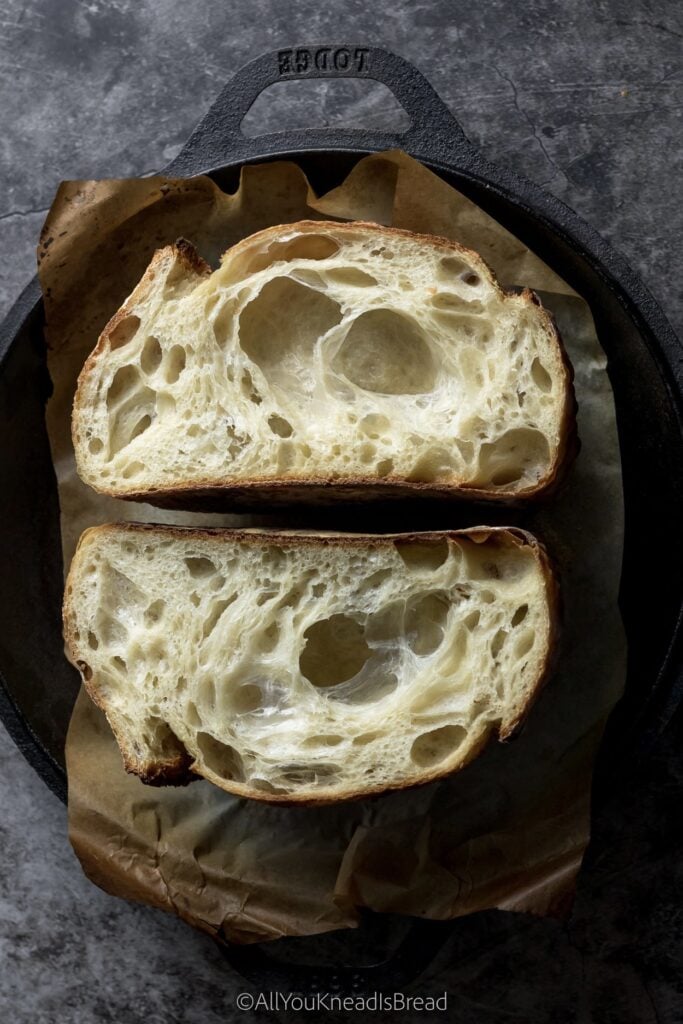
Bread flour has more protein and a higher W value, which means it builds a stronger, more elastic gluten network. This is what you want for chewy, open-crumbed artisan bread, the gluten holds the fermentation gases and gives you that sponge-like structure.
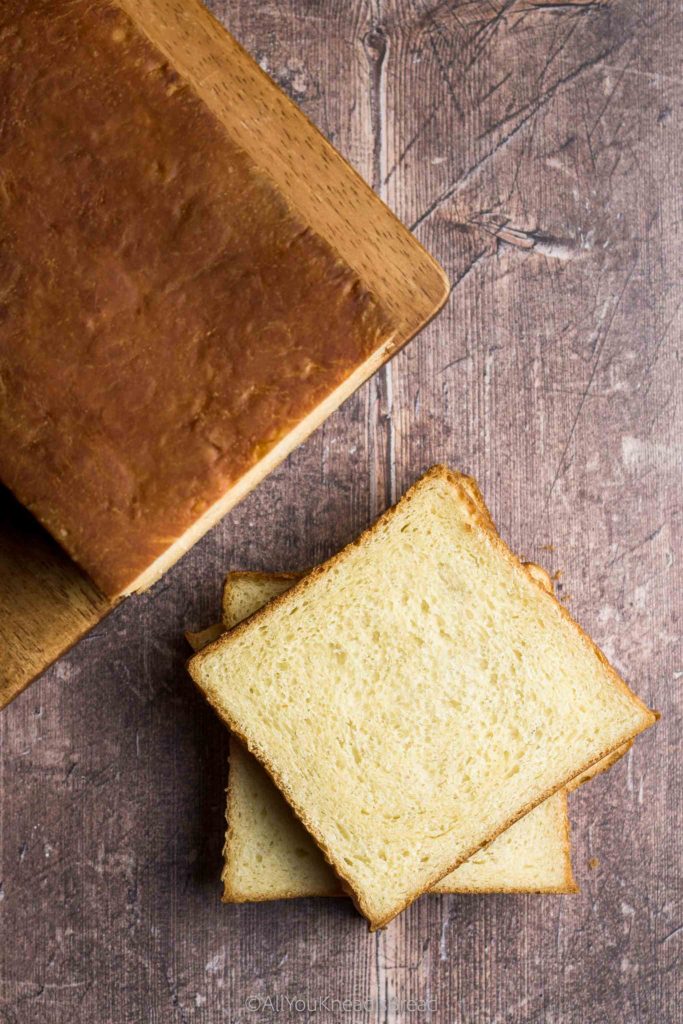
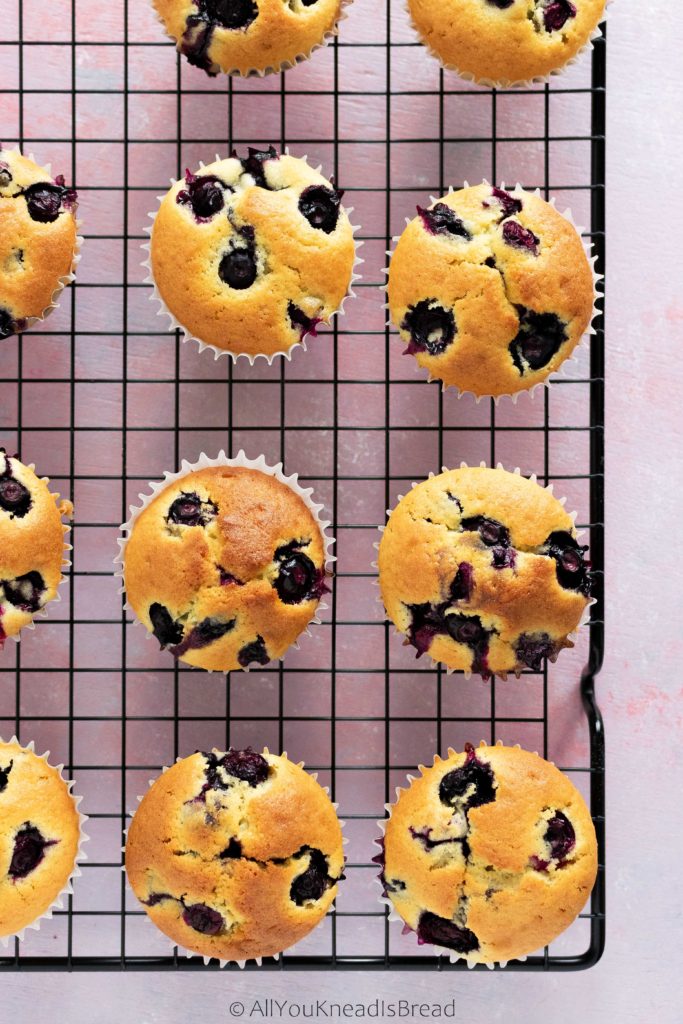
But that same strength is exactly why bread flour doesn’t work well in cookies or muffins. In cookies, too much gluten means the dough doesn’t spread properly, and the texture becomes tough. In muffins, a high-gluten batter becomes dense and rubbery. All-purpose flour gives you enough structure without overdoing it.
For sourdough specifically, bread flour handles long, cold fermentation better. It has the structural endurance to ferment overnight in the fridge without the dough becoming slack and unworkable.
Whole Wheat Flour
Whole wheat flour includes the bran and germ that white flour removes. This makes it more nutritious and more flavorful, but also more challenging to bake with. The bran particles physically interrupt the gluten network, cutting strands before they fully develop. They also “steal” water and hinder the proper development of the gluten network. The result is denser, more compact bread.
Whole wheat also absorbs significantly more water. If you swap 20% of your white flour for whole wheat without adjusting hydration, your dough will feel noticeably stiffer. Add water accordingly.
Best approach: if you’re not familiar with whole wheat, use it as a blend, not a complete substitution. Start with 20–40%, you get complexity and nutrition without losing structure. And as you get more familiar, you can increase the amount of whole wheat until fully substituted.
Cake and Pastry Flour
Cake flour is the opposite extreme: very low protein (7–9%), fine milling, and often treated to be more absorbent. The result is a flour that develops far less gluten, producing the soft, velvety crumb you want in a layer cake or tender biscuit.
The tradeoff: it can’t hold up to longer fermentations, it won’t give you the structure in bread that stronger flours can, and it produces a crumb with much smaller alveoli (holes). Use it for what it’s designed for: delicate baked goods where tenderness is the goal. Or to reduce the strength of other flours.
Rye flour
Rye deserves its own category because it doesn’t behave like wheat flour at all. It contains very little gluten-forming protein; instead, it’s dominated by compounds called pentosans, which absorb massive amounts of water and give rye dough its characteristic sticky, paste-like quality.
In sourdough, rye is incredibly useful in small amounts (5–20%) because it adds enzymatic activity, deepens flavor, and makes starters very lively. In larger quantities, it requires experience. There is a learning curve when it comes to rye as a dough made with it has a fundamentally different structure that doesn’t develop the same way as wheat.

Ancient Grains: Einkorn, Spelt, and Kamut
These older wheat varieties are having a well-deserved moment because they genuinely behave differently and taste different from modern wheat.
- Spelt: extensible and relatively weak (P/L around 0.3–0.5), with a nutty, slightly sweet flavor. It makes beautiful rustic loaves but needs a stronger flour to blend with for high-hydration baking
- Einkorn: the weakest of the group (W 80–160), almost batter-like in high percentages, with a golden color and rich, sweet flavor. Best at 10–30% in blends, or in pan loaves where structure is less critical
- Kamut (Khorasan): silky, slightly buttery flavor, moderately weak gluten. Works surprisingly well in enriched doughs and sourdough blends up to about 30%
The key with ancient grains: they reward patience and blending. Their flavor contribution is exceptional, but their structural contribution is limited. Pair them with a stronger flour, and they become one of the most interesting tools in your baking.
When You Change Flour, You Change a Living System
This is something most guides skip, and it’s genuinely important for sourdough bakers: flour is not just an ingredient in your starter, it’s the habitat.
Your sourdough starter is a community of wild yeasts and lactic acid bacteria that has adapted to the specific flour you’ve been feeding it. The microbes in your starter have selected themselves based on what grows well in that particular environment. Change the flour, and you change the food source, the mineral content, the enzyme activity, and the pH buffering capacity…
The result? Your starter may seem sluggish, unpredictable, or overly acidic for a few feedings. This is totally normal, it’s the adaptation period. The microbial community is adjusting to its new food source.
- After switching flours, expect 2–4 feedings before your starter stabilizes
- Don’t panic if your starter seems slower or smells different in the transition period
- Rye and whole wheat transitions tend to be more dramatic because of higher enzyme and mineral content
- Switching from a complex flour (whole wheat) to a refined one (white bread flour) can make a starter temporarily sluggish — it’s a simpler food environment
Want to understand exactly what’s happening inside your starter during this transition? Read my deep-dive on sourdough microbial science → The science of your sourdough starter
Why Your Recipe Fails When You Swap Flour
This might be the most practically useful section in this guide. You’ve followed the recipe. It’s a tried and true process. You’ve made this before and yet… something went wrong. If the only thing that changed was the flour, here are some ideas of what is probably happening:
Cookies spread too much: The flour you used has lower protein or a lower P/L than the recipe intended. There isn’t enough gluten structure to hold the dough together as the butter melts. The fix: use a higher-protein flour, chill the dough, or blend in a small amount of bread flour.
Bread is dense and tight: Two common culprits: 1) weak flour that couldn’t support the fermentation, or 2) a hydration mismatch where the flour absorbed more water than expected, leaving insufficient water for proper gluten development. Whole wheat swaps, especially, can cause this if hydration isn’t adjusted upward.
Sourdough won’t hold its shape: Classic low P/L problem. Spelt, einkorn, or old whole wheat with degraded gluten can’t maintain tension during proofing. The dough passes the windowpane test but still spreads in the oven. Blend with a high-W flour and tighten your shaping.
Sourdough over-ferments too fast: High-enzyme flour (whole wheat, especially fresh-milled) is pushing fermentation faster than expected. Drop your bulk fermentation temperature or reduce the percentage of whole grain flour.
Cake is tough: Too much gluten development. Either you used a flour with too much protein (bread flour in a cake recipe), or you over-mixed the batter and developed gluten beyond what the recipe intended. Use cake flour or pastry flour and mix only until combined.
Dough is sticky and unworkable: The flour is absorbing differently. Start adding less water than usual and increase water absorption time before adding extra flour (autolyse); the dough will often tighten on its own after a 30-minute rest. If, after a while, it’s still too dry, continue adding water in small amounts and allow the dough to absorb it. Some flours need more time to absorb the water; if you try to compensate the stickyness to fast, you might end up with a very dry dough. Then you will add more water, and then more flour… You see where I’m going, right?
How to Choose the Right Flour
Rather than giving you a list of rules, here’s a framework, four questions to ask before you reach for the flour bag:
- Do I need structure or tenderness? Structure → higher protein, higher W. Tenderness → lower protein, lower W. If it’s bread, you need structure. If it’s cake, you need tenderness. If it’s somewhere in between (soft dinner rolls, enriched dough), you’re in medium territory.
- How much hydration can this recipe handle? Whole-grain flours need more water. Refined flours need less. If you’re swapping flour types, adjust hydration — usually add water in batches of 5–10% extra when moving toward whole grain, reduce slightly when moving to a finer flour.
- Do I need extensibility or strength? Extensibility (low P/L): for thin pizza, flatbreads, anything you’re stretching. Strength (high P/L): for upright loaves, high hydration bread, anything that needs to hold its shape during a long proof.
- Am I fermenting this dough? Fermentation favors stronger flours. Long, cold fermentation especially needs high W to prevent the dough from degrading. Short, same-day recipes can work with weaker flours.
The Blending Approach — What the Pros Actually Do
Professional bakers rarely work with a single flour. They use blends because no single flour perfectly covers all the variables they’re managing at once.
Here’s the logic: you want flavor complexity from whole grain flour, but the structure of bread flour. You want the extensibility of spelt, but the strength of Manitoba. Blending lets you dial in exactly the behavior you’re after.
Practical blending examples:
- Bread flour + 20–30% whole wheat: strong structure with added flavor, deeper color, more mineral complexity
- All-purpose + 10–20% cake flour: softer crumb in muffins, quick breads, or enriched doughs without going full cake territory
- Bread flour + 5–15% rye: boosts fermentation activity and adds earthy, complex flavor without losing structural integrity
- Bread flour + 20% spelt: silkier dough feel, nuttier flavor, slightly more extensible — great for batards and oval loaves
- High-strength flour + 10–20% einkorn: adds golden color and sweetness, while the Manitoba holds everything together
Blending is a great approach when you’re following a recipe from someone who lives in a different country. For example, in North America, even all-purpose flour is quite strong, so making a batch of muffins from someone in South East Asia, might not turn out the same. Knowing how the flour in your region behaves is the key to succeed no matter where the recipe came from,
Final Thoughts: Flour Is the System
If there’s one idea to take from this guide, it’s this: flour isn’t a static ingredient you add to a recipe. It’s a dynamic system with its own chemistry, biology, and mechanical properties, and understanding it gives you control that no recipe can give you on its own.
The baker who knows why bread flour behaves differently from all-purpose flour is able to diagnose, adapt, and create with intention. They know why a dough feels tight, why fermentation is running fast, and why a loaf spreads when it should have risen.
This is the foundation. Everything else in baking (hydration, fermentation timing, shaping, scoring) sits on top of the flour decision.
If you want to stop guessing and start choosing your flour with confidence:
Frequently Asked Questions
What is the difference between bread flour and all-purpose flour?
Bread flour has a higher protein content (12–14%) and a stronger W value, which builds more gluten and gives bread its chewy, open structure. All-purpose flour (10–12% protein) is more versatile but produces a softer, less structured result. For bread, bread flour is generally better. For cookies, cakes, and most other baking, all-purpose is your everyday option.
What does the W value mean in flour?
W measures the overall strength of flour — technically, it’s the energy required to deform a small bubble of dough until it bursts. A low W (80–160) means weak, extensible flour that works for delicate baking and short-process recipes. A high W (320+) means strong flour designed for long fermentation, high hydration, and enriched doughs like brioche and panettone. Most supermarket bread flours sit around W 250–280 without telling you.
Can I substitute bread flour for all-purpose flour?
Yes, but you need to adjust your expectations. Your go-to 70% hydration sourdough with bread flour will feel more like a 85% hydration when you use all-purpose flour. Bread flour creates more gluten, so it needs more water. If you are baking bread, adjusting the hydration is key. If you only have bread flour but want to make cookies, a blend using starch will help reduce the gluten amount and reduce the chances of chewier and less spreadable cookies and tougher cakes.
What is the P/L ratio in flour?
P/L measures the balance between a flour’s tenacity (P — how much it resists stretching) and its extensibility (L — how far it stretches before breaking). A balanced P/L around 0.5 works well for most sourdough. High P/L dough fights back during shaping and needs more resting time. Low P/L dough spreads too easily and struggles to hold an upright shape. This ratio is one of the most useful predictors of dough behavior that most home bakers have never heard of.
Why does changing flour affect my sourdough starter?
Your sourdough starter is a living community of wild yeasts and bacteria that has adapted to the specific flour you feed it. Switching flours changes the food source, enzyme activity, and mineral content of that environment. The microbial community has to rebalance — expect 2–4 feedings before your starter’s behavior stabilizes. This is normal and not a sign that something is wrong.
Why do my cookies spread too much?
Excess spread usually traces back to flour. Lower-protein flour — or a flour with a very low P/L ratio — doesn’t build enough gluten structure to hold the dough in place as the fat melts during baking. Switching to a flour with slightly more protein or a higher P/L helps. Chilling the dough before baking also reduces spread by slowing the butter melt.
What ancient grain flours are best for sourdough?
Spelt (20–30%), einkorn (10–20%), and kamut/khorasan (up to 30%) all work beautifully in sourdough blends. They add complex flavor that modern wheat simply can’t replicate. The catch: all three have weaker gluten than modern bread wheat, so they need to be paired with a stronger flour if you want an upright, well-structured loaf. On their own, they tend to produce flatter, denser bread — which can still be delicious, just different. It is possible to bake a good loaf without blends, but it takes time to learn and understand their behaviour and find a process that works for you. These flours are not cheap, so blends tengo to me more cost-effective as well.
If you have made it this far, thank you! I hope this guide answered most of your flour questions. And if it didn’t, you can always reach me by email or drop a comment below. If you are still stuck with sourdough, I have a few more guides that can be helpful as well. And all my recipes come with clear explanations of each step.
Happy Baking!
For more recipes, baking tips, and scientific insights into bread making, subscribe to my blog and stay updated with the latest in bread baking!
If you make any of my recipes, let me know what you think! As always, you can find me on Instagram, Pinterest, and Facebook. I also have a few videos up on my YouTube channel.
(This post contains affiliate links, if you purchase something from these links I will make a small commission that helps me run this blog, but you will not be charged any extra money 😉 )